
CPD Accreditation Criteria Overview
The Continuing Professional Development (CPD) evaluation serves as an ongoing mechanism for enhancing the quality and effectiveness of workforce development. CPD can be delivered by a range of providers, including training institutes, academic institutions and professional bodies. Evaluation integrates various periodic review exercises and assessments across different CPD offerings to ensure relevance and impact.
The main goals of CPD evaluation are:
- To support the development of a culture of continuous quality improvement among CPD providers and participants;
- To assess the evolution and effectiveness of CPD activities and promote ongoing enhancement of their quality and relevance;
- To provide stakeholders, such as public health professionals, employers and policymakers with transparent information about the performance and outcomes of CPD initiatives;
- To support the recognition and credibility of CPD certifications and learning outcomes within the public health sector.
The self-evaluation begins with a brief introductory section to contextualise your CPD familiarise reviewers with your course’s context.
There are 4 main themes to the CPD Accreditation consisting of:
1. Course Aims and Decision-Making
The first set of criteria refer to the aims of the CPD course and the structures in place to support its development and delivery. Reviewers should consider whether the course has clearly stated aims and learning outcomes that are consistent with its purpose and appropriate to its intended audience. They should assess how these aims align with the mission and strategic priorities of the host institution and whether the course demonstrates a meaningful contribution to public health practice. Particular attention should be paid to whether the course outlines its distinctiveness and intended impact in areas such as workforce development, community engagement or policy. Reviewers should also examine the course’s organisational arrangements and governance. They should determine whether there is a clear structure in place that supports the effective planning and delivery of the course and whether decision making is clearly allocated and involves relevant stakeholders.
2. Participants & Engagement
The second set of criteria refer to the participants and delivery of Continuing Professional Development (CPD) courses. Reviewers should consider whether the intended audience and admission procedures are clearly defined and appropriate in light of the course aims. They should assess the inclusiveness and transparency of participant selection and whether these processes are consistent with the purpose and learning objectives of the course. Reviewers should also review whether, if applicable, the eligibility criteria ensure participants are suitably prepared to benefit from the course. Reviewers should examine how the CPD course is structured and delivered and determine whether the teaching methods and content are aligned with the intended learning outcomes. They should analyse whether the course supports the practical application of learning. Where assessments are used, their alignment with learning outcomes and their contribution to the learning process should be evaluated. Particular attention should be paid to whether the course design supports engagement and accessibility. Finally, reviewers should assess how participation is defined and recognised, including the clarity and transparency of any certification or credit arrangements. They should consider how the requirements for recognition are communicated, implemented and recognised.
3. Resources
The third set of criteria refer to the resources available to support the delivery of Continuing Professional Development (CPD) courses. Reviewers should consider whether the course is supported by an appropriate and adequately qualified teaching team and whether the physical, digital and learning resources are sufficient to meet the stated aims and learning outcomes. They should assess whether the trainers possess relevant academic or professional expertise and whether administrative and technical support roles are clearly defined and effectively contribute to the organisation and delivery of the course. Reviewers should also examine whether the course is supported by suitable teaching and learning materials and whether these are accessible and aligned with the intended learning outcomes. This includes the provision of essential and supplementary resources such as core texts, online platforms, databases or other relevant tools that enhance the learning experience and support achievement. In addition, reviewers should assess the clarity, accuracy and accessibility of the public information provided by the institution in relation to its CPD offer. This includes information on the content and structure of the course, its intended audience, duration, expected learning outcomes and the type of certification awarded upon completion. Reviewers should consider whether this information is up to date and whether it supports informed decision making by prospective participants and stakeholders.
4. Quality Assurance, Financing and Integrity
The final set of criteria refer to the systems in place to ensure quality, transparency and integrity in the design and delivery of Continuing Professional Development (CPD) courses. Reviewers should consider whether there is a clear and coherent approach to quality assurance and enhancement that supports regular course review and continuous improvement. They should assess how feedback from participants and relevant stakeholders is collected and used to inform course development. Reviewers should also determine whether the course remains responsive to changes in workforce needs and public health priorities and whether any external reference points or standards contribute to its ongoing relevance and quality. Reviewers should also examine how the course is financed and whether financial arrangements are transparent and appropriately managed. They should consider the extent to which the institution ensures the independence and integrity of the course by identifying and managing any actual or potential conflicts of interest. Particular attention should be paid to whether safeguards are in place to prevent undue influence from external funders or partners and whether internal procedures support ethical and impartial delivery of the course content.
Provide a small (1 page maximum) SWOT analysis (Strengths, Weaknesses, Opportunities and Threats) of the Training. This analytical document should include:
- Review/reflect on the strategic goals of your Training.
- Analyse its strengths and weaknesses (factors intrinsic to the Training which enable or hinder the achievement of strategic goals).
- Identify opportunities and threats (external factors which can positively or negatively affect main goals)
Propose an improvement plan for your Training which answers the following questions:
- What changes are planned to achieve the main objectives?
- Do the improvement proposals address the weaknesses?
- Are those proposals supported by the strengths?
- Priority and time for implementation
- Indicators of implementation
CPD Resources

CPD Accreditation Handbook
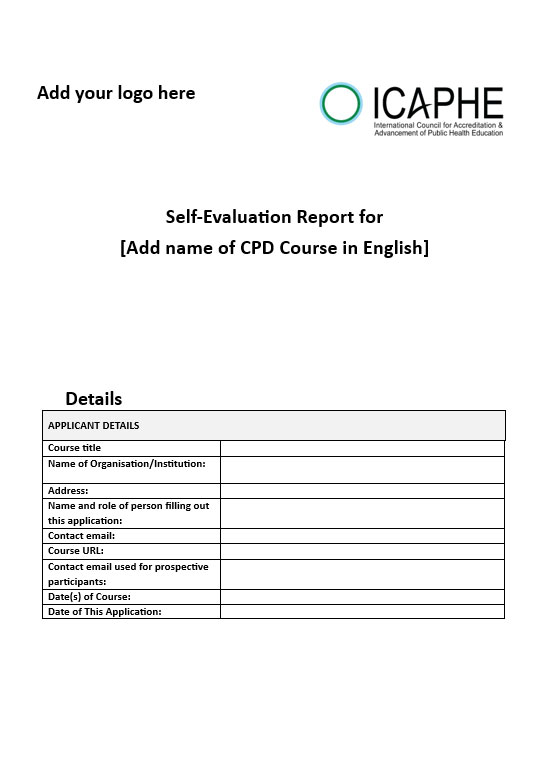
CPD Self-Evaluation
Report Template

CPD Accreditors Manual
© ICAPHE 2025