
CPD Accreditation Criteria Details
The self-evaluation begins with a brief introductory section to contextualise your Course. While some of this content may be repeated in the main body of the report, this introduction serves to familiarise reviewers with your Course’s context.
The Self Evaluation Report should address each applicable criterion demonstrating how your Course complies with it (maximum of 2 pages each). Each criterion should be supported by relevant evidence which may be presented in different ways. Documents may be submitted with the report, or the School may provide links to electronic materials. Some documentation (e.g. examples of assessment papers) may be made available for review during the site visit. This may be discussed with the Accreditation Review Panel. If there are criteria which are not applicable to your particular circumstances or context, you are obliged to issue a statement informing the reviewers why this is the case.
Completed self-evaluations should be submitted approximately two months before the intended review date, along with a draft meeting schedule highlighting the individuals to be interviewed.
1. Course Aims and Decision-Making
1.1. Course Aims, Outcomes, Distinctiveness & Social Accountability
The course clearly articulates its aims, learning outcomes and distinctiveness, indicating alignment with the host institution’s mission and demonstrating that it serves an identified need with intended impact on learners and professional practice.
1.2. Organisation & Decision Making
The course is supported by a clear organisational structure, with designated leadership and active stakeholder involvement to ensure effective design, approval delivery, accountability and continuous development.
2. Participants and Engagement
2.1. Audience & Admissions
The targeted audience and admission / registration processes are clearly defined, transparent, inclusive and appropriate to the course aims and outcomes. Appropriate outreach and criteria ensure participants are suitably prepared to benefit from the learning experience.
2.2. Learning & Assessment
The course is designed and delivered using appropriate, inclusive and evidence-based learning methods, with clear outcomes, structured content and assessment (where applicable) that supports the application of learning in practice.
2.3. Participation & Awards
The course clearly defines learner participation, recognises engagement through appropriate certification or CPD credit and ensures transparency in how these awards are calculated, issued and recognisable.
3. Resources
3.1. Human & Physical Resources
The course is supported by suitably qualified trainers and appropriate physical, digital and learning resources that are adequate and relevant to meet its stated aims, outcomes and participant needs.
3.2. Public Information
Courses ensure clear, accurate, objective, up-to-date and easily accessible information is available for prospective participants, stakeholders and the public at large.
4. Quality Assurance, Financing and Integrity
4.1. Quality Assurance & Enhancement
The course operates within a clear system of quality assurance and enhancement that ensures regular review, integrates stakeholder feedback and supports continuous improvement in line with evolving workforce needs and public health priorities.
4.2. Financing & Conflicts Of Interest
The course is transparently financed and implements safeguards to ensure it is free from undue commercial influence or conflicts of interest, protecting the integrity and independence of its educational content.
CPD Resources

CPD Accreditation Handbook
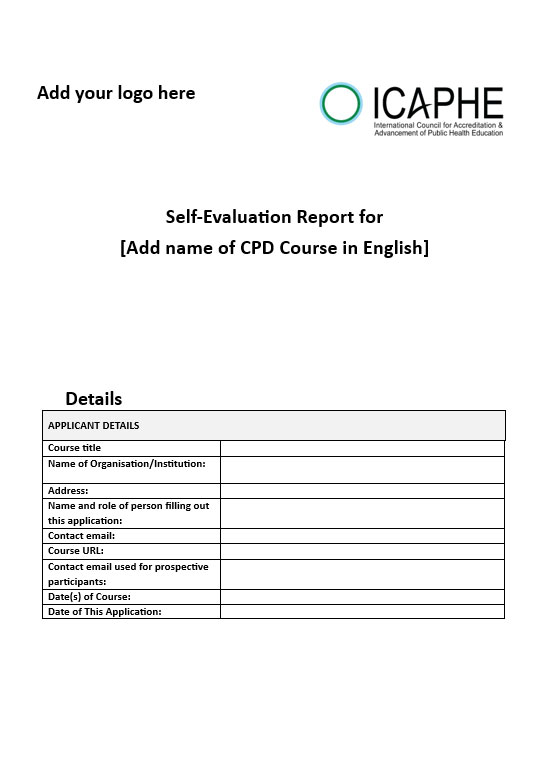
CPD Self-Evaluation
Report Template

CPD Accreditors Manual
© ICAPHE 2025